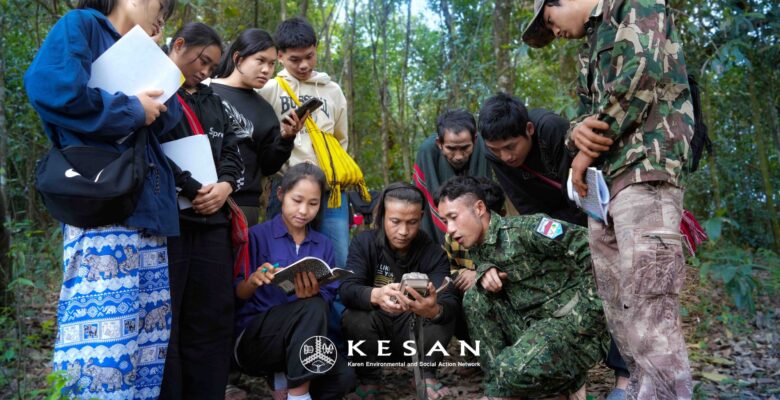
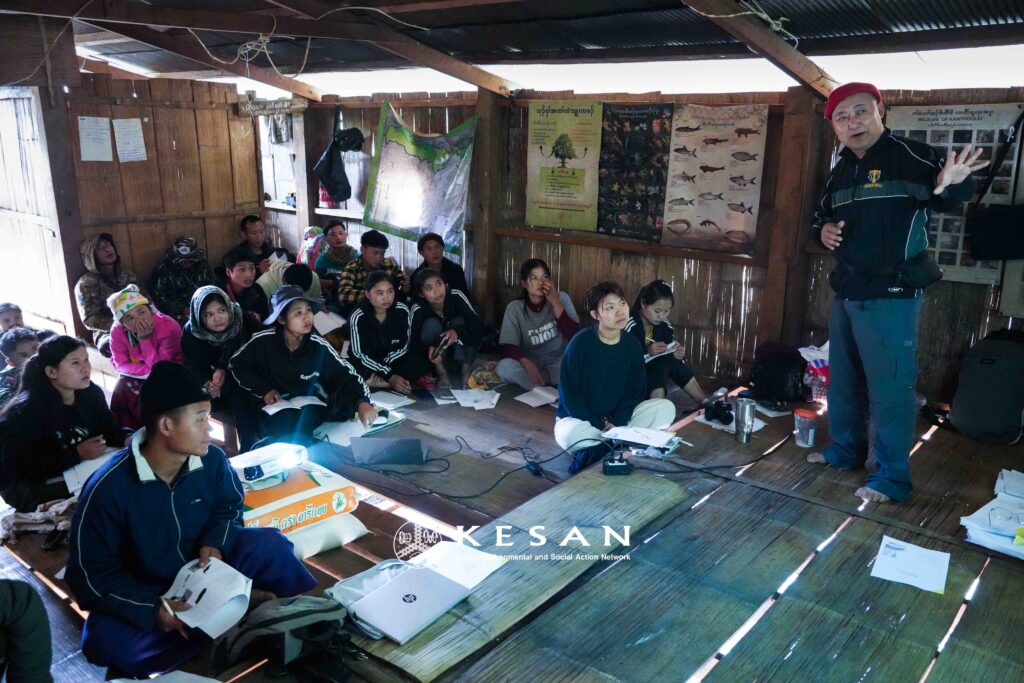
From February 23rd to 28th, 2026, a biodiversity research training was conducted at the Kheshorter Community Forest Center in Paw Law Pu, Luthaw Township, located in the north‑western part of the Salween Peace Park. A total of 30 people joined the training, including members of the Women Research Team, officers from several departments of the Karen National Union (KNU) — such as the Kawthoolei Forestry Department (KFD), Kawthoolei Agriculture Department (KAD), and Kawthoolei Livestock and Fishery Department (KLFD) in Mutraw District — as well as local villagers from different communities.
The training was led by Saw Blaw Htoo, Wildlife and Forest Research Expert from KESAN, who said:
“We, the Indigenous Karen people, are blessed to live among rich biodiversity that supports and sustains us. We benefit from them, but our knowledge to study and understand our biodiversity is still limited.
This training aims to equip our new generation and local people with modern research skills so they can document and study their local biodiversity by combining Indigenous knowledge with scientific methods. To advocate for the recognition of our Indigenous people’s rights to self‑determination, it is important to show the biodiversity we manage on our own land. And we need these research skills for that.
During the six‑day course, participants learned research techniques on plants, gibbons, insects, fish, frogs, birds, and reptiles, as well as basic photography skills and how to use GPS devices and camera traps. The training covered multiple methods such as point counts, line transects, distance sampling, acoustic surveys, and spatial mapping to estimate wildlife abundance and species richness.
For practical sessions, participants were divided into small groups every morning and assigned to predetermined survey points or transect lines across the study area, studying birds and gibbons on different days. At each observation point, researchers recorded species observed, number of individuals, time of detection, estimated distance between observer and animal, compass direction, and other details.
Naw Shu Bu, a member of the Women Research Team, shared her experience:
“During the practical survey on gibbons, we were divided into five groups and assigned to different points where gibbon calls usually come from. We used books, pens, cameras, GPS devices, and compasses to record our findings. Our group heard gibbon calls from six locations. Other groups heard calls from eight locations, four locations, and some only from three locations. We also had to listen carefully to identify whether the gibbon call was solo, duet, or from multiple individuals. When we returned to the center, our trainer, Saw Blaw Htoo, mapped all the data on the computer. The results showed that there were at least three groups of gibbons within the area where we conducted the survey. This activity helped us a lot in understanding survey techniques and determining wildlife population numbers.”
Moreover, the training brought together not only the Women Research Team and local villagers but also officers from multiple KNU departments within the Salween Peace Park. By integrating the research skills they learned into their work, relevant KNU departments will be better able to develop conservation plans and disaster management strategies.
Saw Blaw Htoo added:
“By researching the species we have, we will know which ones require our attention for conservation, especially for the KFD. While there are insects that benefit us, such as ants and bees, there are also insects that harm our crops. By studying these species, we can make plans to address pest outbreaks, which directly supports the work of the KAD. By studying fish, the Kawthoolei Livestock and Fishery Department (KLFD) will be able to manage fish populations – including spawning sites – or help create food security through a fish hatchery program. GPS and mapping skills will support the demarcation and mapping of forests, land, lakes, and more. Overall, this training will contribute to conservation and disaster management across the Salween Peace Park.”
To see all the training photos, please visit the following link: