Date: December 22, 2025
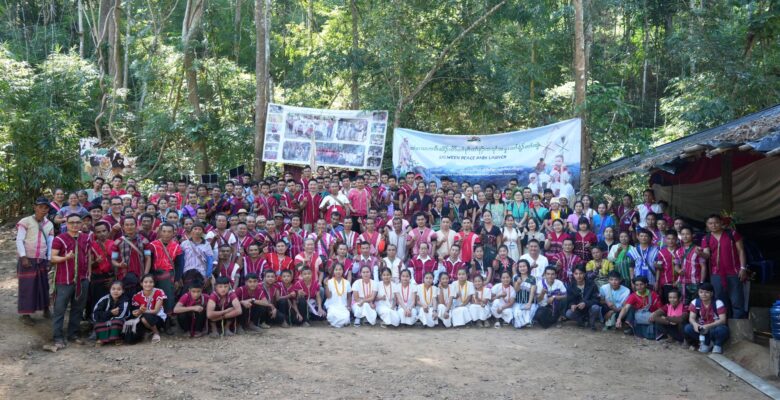
On December 17-19, 2025, as the Myanmar junta continued bombing and murdering civilians across Burma in ferocious attempts to retake liberated territory from resistance groups and impose its fake “election,” a very different exercise in grassroots democracy was taking place deep in the forests of Salween Peace Park, Kawthoolei.
This was the 6th General Assembly of the Salween Peace Park. A total of 195 representatives (49 women and 146 men) from Indigenous communities, civil society organizations, and the Karen National Union (KNU) government gathered to review last year’s activities, discuss policy, and deliberate on future actions.
Although any notion of peace negotiations with the Myanmar military has long been shattered, the Salween Peace Park continues as a living, real-world example of self-determination in action, as Indigenous communities assert cultural teachings of “eat and care for” (Aw K’Taw) to protect their waters, lands, and forests.
Salween Peace Park thus contributes directly to the Karen National Union’s (KNU) struggle for self-determination, which will mark 77 years in January. The peace park’s efforts to build peace and self-determination, uphold ecological integrity, and promote cultural revitalization honour the legacy of all those who have suffered (and continue to suffer) in the decades-long struggle to defend ancestral K’nyaw (Karen) lands. “We don’t beg for our rights in Naypyitaw, but we are exercising our self-determination right here in our ancestral territory,” declared Saw Paul Sein Twa, Chairperson of Salween Peace Park.
The peace park’s working groups provided updates on demarcation of Indigenous kaw territories, establishment of community wildlife sanctuaries, community forest monitoring, the launch of cultural curriculum in area schools, documentation of historical sacred places, establishment of community rice banks, and much more. The Salween Peace Park Climate Change Strategy was also adopted, outlining a five-year plan for reforestation, renewable energy development, and other climate-mitigation activities. Pollution in the Salween River was also discussed, with plans for additional testing to assess risks to riverine communities.
In 2025, Salween Peace Park marks two milestones on the pathway to recognition as an Indigenous territory. On December 18, on the 7th anniversary of the park’s founding, P’doh Thaw Thi Bweh from KNU Central Headquarters presented Salween Peace Park with an official declaration committing the KNU to “upholding and supporting the Salween Peace Park as a durable framework for peacebuilding, Indigenous self-determination, and ecological stewardship in Kawthoolei.”
It was also announced that Salween Peace Park was recognized on December 1, 2025, as a Karen Indigenous Community Conserved Territory in the United Nations Environment Program’s Global ICCA Registry. This recognition locates Salween Peace Park in the global movement for Indigenous-led biodiversity conservation and climate change mitigation. The people of Salween Peace Park are working together and building international alliances, not only for conservation but also to secure recognition of their rights as Indigenous Peoples in their ancestral territories.
Together with other emerging initiatives in the K’nyaw territory of Kawthoolei, the Salween Peace Park is a dedicated territory for peace, Indigenous self-determination, cultural revitalization, and environmental sustainability. As such, the peace park offers much-needed hope and inspiration in a world facing intensifying oppression, violence, climate change, and biodiversity loss.
Salween Peace Park’s sister initiative to the northwest, the Thawthi Taw-Oo Indigenous Park in Kawthoolei’s Taw Oo District, successfully held their first General Assembly and elected their Governing Committee earlier this month. The Salween Peace Park General Assembly congratulates the people of Thawthi Taw-Oo Indigenous Park. It welcomes them to the growing movement for Indigenous-led conservation in Burma and worldwide.
For more information, please contact:
Saw Paul Sein Twa – Tel: +66 (0)81 724 7093
Download this press release in multiple languages here: