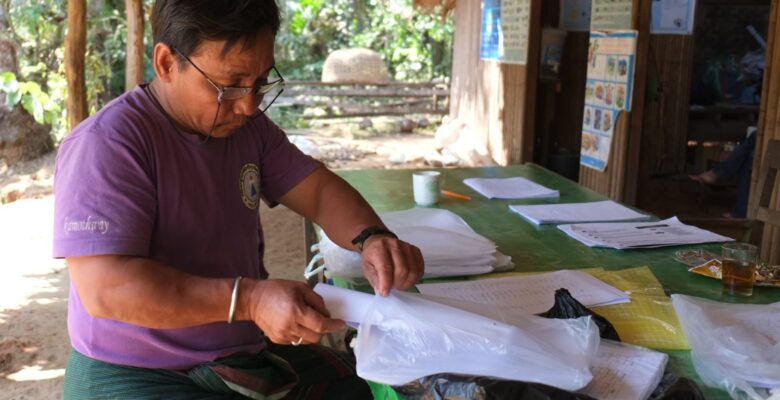
The Karen Environmental and Social Action Network (KESAN) and the people of Ler Doh Soe Township, Mergui-Tavoy District, are mourning the loss of a dedicated community leader, caretaker, and Indigenous rights defender, Saw Keh Doh, who passed away from illness.
Saw Keh Doh was born on May 31, 1967, to Naw Paw Lay Zar and Saw Geh Ler in K’Hser Doh Township, Mergui-Tavoy District. He was the second of four children, with two brothers and one sister. After completing high school, he set aside his own education to support his family. He traveled to Thailand and Cambodia to earn money, helping his parents repay their debts and ensuring their wellbeing.
On April 20, 1994, he married Naw May Tin, and together they raised four children—one daughter and three sons. The family relied on upland farming and orchards for their livelihood.
Once the family’s situation stabilized, Saw Keh Doh returned to pursue the dream he had postponed for many years. In 2003, he enrolled at Mawlamyine University in Mon State, majoring in Geography. After graduation, he joined the Myanmar Red Cross Society, providing first aid, emergency relief, and disaster response to his community and internally displaced persons (IDPs). He later joined the Malaria Elimination Program, helping protect his community from malaria.
When Italian-Thai Development PCL (ITD) began constructing the Dawei Deep Sea Port and Special Economic Zone ̶ first initiated in 2008 as a joint venture between Thailand and Burma ̶ the surrounding communities faced widespread land grabbing, forced relocation, and unfair or absent compensation. In response, Saw Keh Doh and other local leaders formed the Community Sustainable Livelihood Development (CSLD) group to help villagers defend their land rights and demand fair compensation. He also co-founded the Dawei Development Association (DDA), an organization advocating for green development, land and property rights, natural resource management, and sustainable regional development.
As Secretary of CSLD and Eastern Region Coordinator of DDA, he worked tirelessly to protect community land and support families whose land had been taken. In 2013–2014, he was among 64 researchers who helped produce the landmark report “Voices from the Ground: Concerns Over the Dawei Special Economic Zone and Related Projects”, which was submitted to the National Human Rights Commission of Thailand. The report detailed forced evictions, inadequate compensation, lack of consultation, restricted access to information, and other human rights abuses. In October 2014, Saw Keh Doh and other affected community members testified at an NHRCT public hearing, bringing their voices directly to national attention. Through persistent effort—press conferences, community mobilization, and advocacy—civil society inside Burma and Thailand successfully pressured ITD to withdraw from the project, which remains stalled to this day.
Saw Keh Doh also brought a life-changing gift to his village. When road construction and mining activities polluted the local rivers, turning the water muddy and unsafe, he reached out to humanitarian organizations and secured support for the installation of a water pipe system from the waterfall to the village for a daily use. Today, the entire community continues to benefit from this tap water system ̶ a legacy born of his determination.
After the 2021 military coup in Burma, many youths, students, and government workers involved in the Civil Disobedience Movement (CDM) fled to rural areas for safety. During this critical time, Saw Keh Doh worked day and night to provide food, shelter, and safe passage to those escaping the junta’s violence. When armed conflict displaced many villagers, he again stepped forward, seeking humanitarian aid to support them.
His wife, Naw May Tin, shared:
“Sometimes he was gone for a month. Sometimes he returned home very late at night. I always understood him because I supported what he did. He was happier helping others in the community than staying with his own family. He told me he would be happy if people still remembered his name after he died. He was that kind of person.”
Beyond resisting the Dawei SEZ, Saw Keh Doh also took part in campaigns with other CSOs in the Tanintharyi region opposing destructive projects, including mining operations by Japan-based companies, large-scale oil palm and rubber plantations, and hydropower dams that threatened the land, rivers, and livelihoods of his community.
In 2022, he became the Chief Judge of Ler Doh Soe Township, Mergui-Tavoy District. In 2026, he was re-elected for a second term and continued to serve with unwavering commitment and integrity until his final days.
As an organization that worked closely with Saw Keh Doh in the struggle for Indigenous people’s land rights, we will never forget his dedication, courage, and passion.
Saw Keh Doh leaves behind a legacy of courage, compassion, and relentless commitment to justice. His work brought justice to countless families, safeguarded community land, and strengthened the movement for Indigenous rights across the region. Though he is no longer with us, his spirit lives in the forests he defended, the rivers he protected, and the communities he uplifted.